A Wine Lover’s Guide to Alentejo, Portugal
This article was first published on my Substack: The Wine Edit – I’ve reproduced an adapted version of it here in an attempt to group my wine guide series together in one place.
While the Douro Valley might win Portugal’s prize for Most Majestic Wine Region, Alentejo has a quiet, understated charm that rewards those who take the time to get to know it. The landscape is open and undulating, with cork trees everywhere and vines growing over 250 native grape varieties (Portugal is second only to Italy in terms of its number of native grapes). The region is mostly hot and dry, which no doubt helps out with many wineries’ sustainability ambitions to produce more organic and biodynamic bottles. And its winemaking history dates back to Roman times – hence the tradition for fermenting and storing wines in giant clay vessels known as talhas (more about that in my Substack article on Portuguese wine trends).
Alentejo is also the biggest wine region in Portugal, with eight DOC sub-regions, so trying to cover them all in three weeks (not to mention in one article) would be pretty much impossible. Which is why I’m focusing specifically on the vicinity of Évora, which is where I was staying – wineries worth visiting, wine bars, wine shops and other places to taste Alentejan wine.
Planning your trip to Évora and Alentejo
Before you can start tasting your way through the Alentejo wine region, here are the trip essentials:
- Getting to Évora: Your closest airport is Lisbon’s Humberto Delgado, served by direct flights from most major European cities with TAP Air Portugal, KLM, British Airways, easyJet and Transavia, among others. From the US, TAP and United fly direct from Newark. Compare routes on Expedia. From the airport, you can take a direct bus to Évora, or see all transport options from Lisbon on Omio. The journey takes around 1.5 hours.
- Getting around: Évora’s old town is compact and best explored on foot. But if you want to visit wineries, a car is essential, as most estates are spread across the countryside and not accessible by public transport. You can rent one at Lisbon airport or in Évora itself. Note that parking inside the city walls is limited, so park outside and walk in.
- Where to stay: We stayed in an Airbnb in Évora’s old town, which puts you within walking distance of the main wine bars and shops. You can browse places to stay in Évora on Booking.com, or hotels across Alentejo if you’d rather be closer to the vineyards.
- Tours and experiences: If you’d rather not drive, try the Monsaraz and wine tour from Évora, or browse more wine tours around Évora.
- Further reading: For more Portuguese wine regions, see my guides to the Douro Valley, the Algarve and the Azores. Hungry as well as thirsty? Read my guide to restaurants in Évora.
Alentejo wineries
Driving through Alentejo, you’ll see brown signs representing the “Rota dos Vinhos” (wine route) that takes in 70 wineries along its way. I’m sure they’re all worth a visit, but given the limited time available I came up with my own little curated selection: seeking out places that represent both tradition and modernity, both small-scale boutiques and big (but organically certified) businesses. However, bear in mind that some of my research involved finding out a) which places are open on weekends (as I was working during the week) and b) which wineries would let me bring my dog – two criteria that are unlikely to apply to the average visitor!
Fitapreta Vinhos
I came across Fitapreta while researching wine in the Azores because the winery’s owner, António Maçanita, has a strong presence on Pico island as well. I was curious what he’s doing in Alentejo, so I was glad to discover that Fitapreta Vinhos is only around 10 kilometres from Évora and offers a range of tours and tastings. The buildings that make up the winery are absolutely steeped in history: a 14th century ruined palace has been renovated into the main barrel storage facility, complete with a medieval chapel featuring original frescoes that were only recently discovered (apparently Maçanita and team had some time on their hands during covid). But the fermentation tanks are housed in a cork-clad state-of-the-art warehouse that was only built in 2017. Fitapreta is the very definition of that oft-used phrase “where tradition meets modernity”.
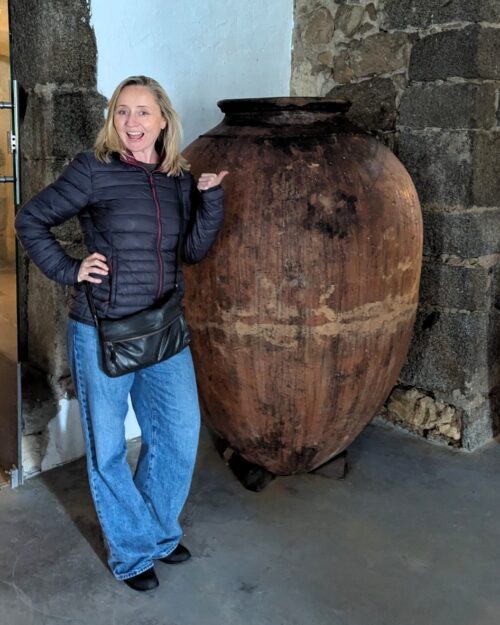
Checking out the enormous talha at Fitapreta!
The tour is as much an exercise in historical storytelling as it is in wine facts – history buffs will love it. At the end, you’ll settle into the industrial-chic tasting room for a flight of wines plus some local cheeses and charcuterie, plus more storytelling about the experimental techniques that have gone into the wines. Maçanita primarily uses semi-carbonic maceration, wild yeasts and not a lot of oak. But he also experiments with skin-contact whites (in the case of his Laranja Mecânica) and amphora-fermented reds (not technically classified as “Vinho de Talha” as they don’t follow the rules). There’s loads to tell, but I won’t spoil the surprises.
Herdade do Esporão
Esporão is one of the few names in Portuguese wines that I routinely see in the Netherlands and the UK (no doubt because they export to a whopping 50+ countries globally). Not only are they doing a great job commercially – they’re also certified organic, so it’s cool to see such a big wine business doing its bit for sustainability. Given Esporão’s size and export credentials, it’s perhaps no surprise that their Alentejo estate – located just outside Reguengos – feels monied. Tastefully monied, but still monied. I didn’t get to tour the winery itself (we had our dog with us and she wasn’t allowed inside) but I did wander through Esporão’s elegant restaurant, wine bar and inner courtyard, dripping with springtime wisteria.
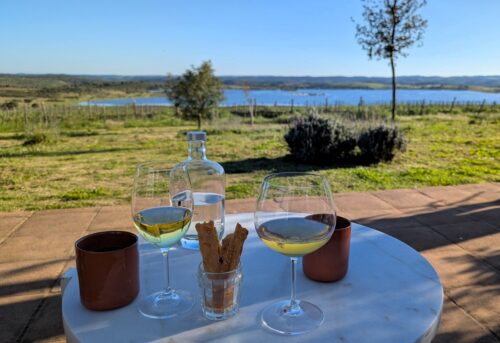
The estate at Esporão
A happy side effect of being banished from the interior, however, was getting to sit outside overlooking green swathes of vines, footed by a large lake, while enjoying a couple of glasses of wine. I’d tried the Esporão Reserva blends on several occasions, but I was excited to taste their Private Selection white: 100% Semillion grapes, fermented in French oak with six months of lees ageing. The 2022 that I drank had the vanilla richness and tropical acidity of a pineapple upside down cake (perhaps you had to have grown up in the UK several decades ago for this reference to make sense). The whole experience – the estate, the décor, the wines – felt very much like I was living my rich life.
Adega José de Sousa
In the heart of Reguengos town, you’ll find a true tribute to Roman winemaking at Adega José de Sousa – home to 114 huge talhas (clay vessels). The winery dates back to 1878 (although it was acquired by José Maria de Fonseca in 1986) and its history is everywhere in evidence. The numbered talhas themselves are impressive enough, but add to that the traditional lagares in which the grapes are foot-trodden and you get a genuine sense of how well Portugal has revived ancient Roman-era techniques.
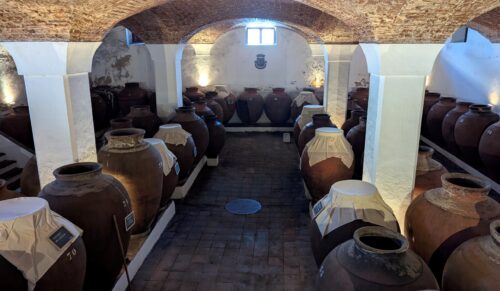
The cellar at Adega José de Sousa
At the tasting after the tour, we worked our way through six of José de Sousa’s wines – including the smoothly easy-to-drink “José de Sousa Reserva” red blend, the flagship “J” that’s only made in the best years (we tried the 2017 vintage), and the “Puro Talha” wines that are made 100% in clay talhas. Both the white and the red introduced me to grapes I’d never heard of (Sarigo and Moreto respectively) and were spicy and savoury with the odd oxidative note. An interesting tasting from an interesting winery.
Quinta do Hossio
While Quinta do Hossio isn’t open to visitors (yet!), they deserve a mention for their style of wine: dry, elegant rosé and light, crushable red – both made from Touriga Nacional and Aragonez – that are a far cry from the powerful wines typically made from those grapes in Alentejo. Hossio is a family-run business, founded just a couple of years ago by a Portuguese-British wife-and-husband team, in the Serra d’Ossa mountains close to Redondo. Well worth a hike around the area, even if the winery isn’t open. You can read more about Hossio’s story and their wines in a full feature here.
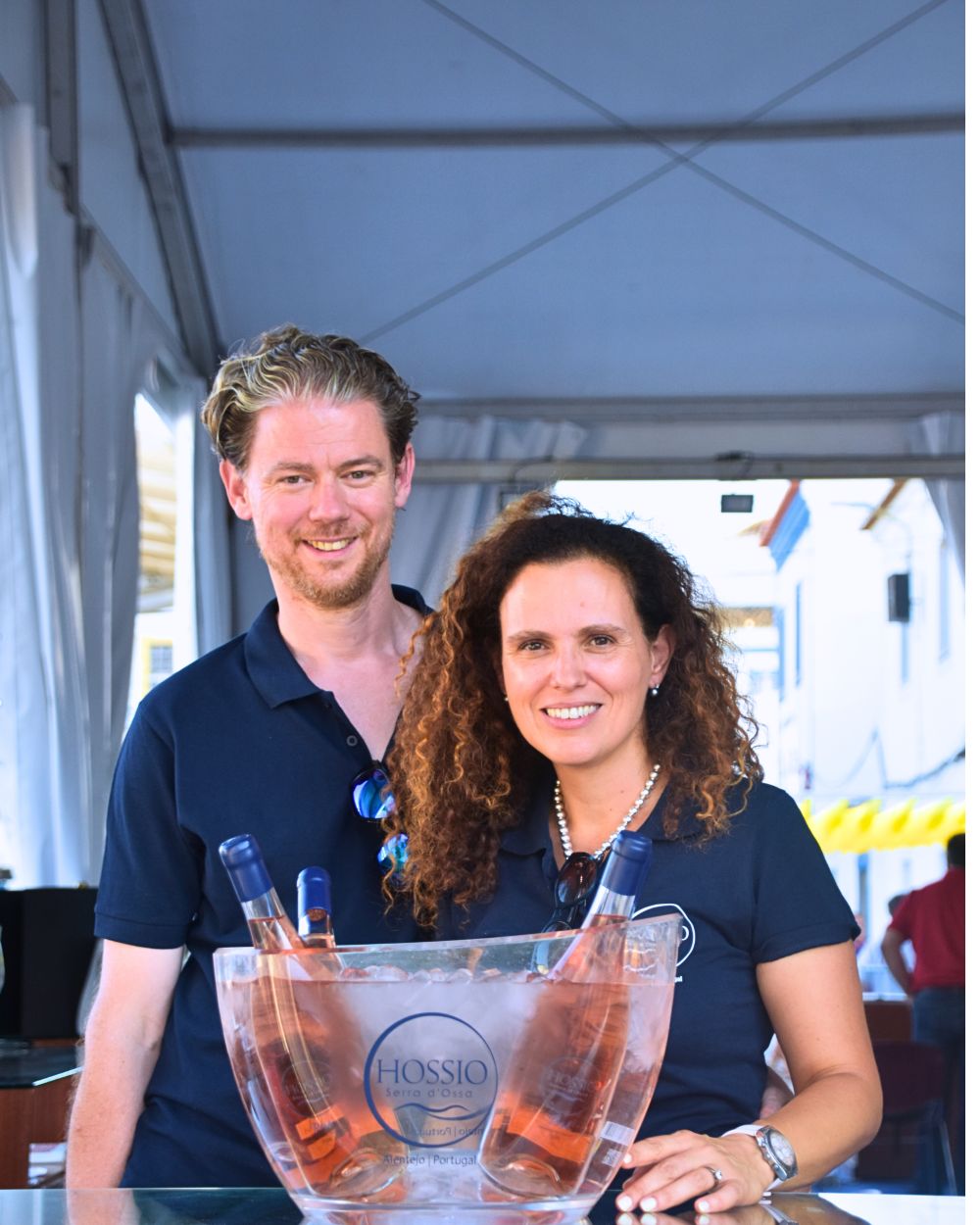
Rute and James Ferrier, Hossio’s founders
Wine tasting in Évora
Visiting Évora, it’s clear that wine is taken seriously: the Évorans (if that’s a word) are proud to show off their region’s glorious grapes. Which is perhaps why there’s a lot of crossover between the city’s wine businesses: shops that offer tastings, bars that also let you buy wine to take home, museums dedicated to wine – you name it.
Rota dos Vinhos do Alentejo
The Comissão Vitivinícola Regional Alentejana (CVRA – or the Alentejo Regional Winegrowing Commission in English) was founded in 1989 to certify, control and protect the Alentejo DOC and vinho regional wines. It also has its own tasting room and interpretation centre (a small museum, effectively) in Évora, which is my absolute top tip for visiting wine lovers. Monday through Saturday, Rota dos Vinhos offers guided tastings every half hour or so – starting with some general information about the Alentejo region and then pouring four wines from some of the 275 wineries that the CVRA represents. Each week, the selection of wines available to taste changes, which means that if you’re in Évora for longer than a week you can go back and get an entirely different tasting. And all for €5 per person!
If you’re so minded, seek out my personal favourites that I tasted at Rota dos Vinhos: the 2019 Santa Vitória Reserva, and the 2016 Foral de Entradas Reserva – both red blends that had spent considerable time in oak, leading to stewed prunes and wet forest floor in the case of the first, and floral violets and black cherries in the case of the second.
Courelas da Torre
Just off Évora’s main square, Courelas da Torre looks like a general natural wine bar, but in fact exclusively sells wines from its own estate on the outskirts of Redondo. The quality can be a little hit and miss: I enjoyed their peachy “Luminoso” orange wine, but their plummy “Felisbela” rosé turned mousy within minutes. A shame because it showed great promise.
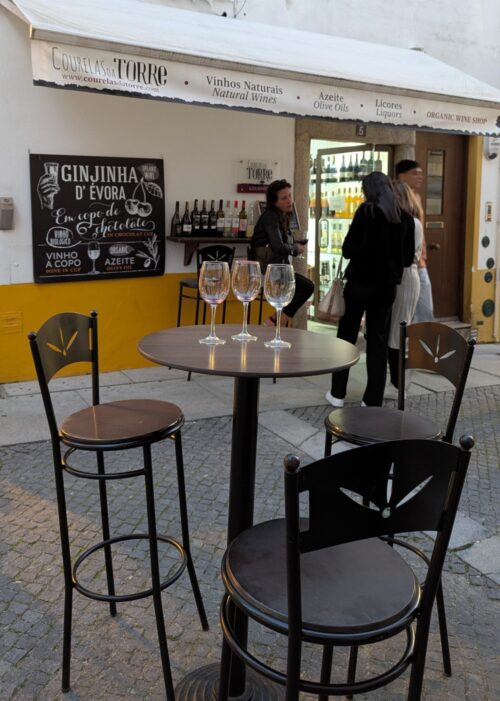
Natural wine bar Courelas da Torre
Louro Wines
Louro’s is a proper old-school wine shop that looks like it’s from a Dickensian novel; the cash till and service area are behind a sort of post office counter, beyond which wooden wine boxes are piled high. I’m not sure whether the owner organises any tastings, but do pop in to have a chat with him (he’s very knowledgeable) and pick up a bottle to take home. Although the selection is small, it’s well curated: selling everything from a €12 fruity Alentejan rosé to the fearsomely expensive, and rather intimidating, Pêra-Manca by Cartuxa – a limited edition wine that’s only produced in exceptional vintages.
Cartuxa
Adega Cartuxa (the winery itself) is located only a couple of kilometres north of Évora, but if you don’t have a car, don’t feel like the walk, or don’t want to do a full tour-with-tastings, you can pop into Enoteca Cartuxa (the wine bar) in the city centre instead. Almost all of Cartuxa’s wines (from their entry level Monte de Pinheiros and EA labels to their premium Cartuxa and Scala Coeli labels) are available by the glass as well as by the bottle, enabling you to try a range of different styles and price points. Unfortunately, they don’t offer a flight so you’ll need to come up with your own (or ask for some advice).
We tried six wines in total, with highlights for me being the Assario-based Foral de Évora (citrussy white) and the smooth, caramel-flavoured Cartuxa Rosé made from Touriga Nacional – both Alentejo DOC wines. On the reds, I was a fan of the ripe, polished Cartuxa Colheita blend, but it was also interesting to try their organic Vinho de Talha (again, fermented in clay vessels).
Ervideira
Similar to Cartuxa, Evideira’s family-run winery is about 30 minutes’ drive southeast of Évora (near Monsaraz), but they have a shop and tasting room in the centre of Évora’s old town. For €10, you get to taste five wines – which felt like pretty good value, although there wasn’t a whole lot of explanation about them.
Ervideira’s white Conde d’Ervideira Reserva is apparently award-winning, and I loved the 2023’s tropical acidity tempered by several months in Hungarian oak barrels. Their entry level rosé is phenomenally good value summer slurp wine (look for Flor de Sal on the label) while their reds offer more complexity. Try their “Vinho da Agua” to find out what 12 months at the bottom of a cool lake does to a typical Alentejan red blend! And finally, Ervideira’s Tinta Calada has been fortified to 21% and tastes like a smart tawny port: plenty of dried fruit, vanilla and well-balanced acidity. Everything you taste is available to buy, and you’re sure to walk out with at least a bottle or two.