A Wine Lover’s Guide to the Azores, Portugal
This article was first published on my Substack: The Wine Edit – I’ve reproduced an adapted version of it here in an attempt to group my wine guide series together in one place.
A few weeks ago I wrote about Azorean terroir: or rather, the nearly impossible set of climactic conditions in which plucky Azorean winemakers manage – somehow, against all odds – to grow grapes and produce wine. Windswept is an understatement; damp is an understatement. During the six weeks I spent there, the Atlantic gales threatened to sweep my Yorkie up into their salty gusts; the humidity levels meant there was no such thing as a good hair day; and I was jolted from sleep by a magnitude 5.3 earthquake. All this is business as usual in the Azores.
But then there’s the soil: volcanic islands = lava soils, full of minerals, easy drainage and a good ability to regulate temperature. Rather important when you’re battling with elements like these.
Planning your trip to the Azores
Even if you plan to travel to Pico or one of the other islands, the chances are you’ll start in Ponta Delgada on São Miguel. Here are the trip essentials to get you started:
- Getting to the Azores: João Paulo II Airport in Ponta Delgada is the main hub for the Azores. TAP Air Portugal flies direct from Lisbon and Porto, and Azores Airlines also flies from Lisbon. Transavia flies direct from Amsterdam and British Airways from London Heathrow, both seasonally, so outside summer most travellers connect via Lisbon. From the US, Azores Airlines flies direct from Boston and New York, and United flies from Newark in season. Compare all times and prices on Expedia or Omio.
- Island hopping: Once on São Miguel, Azores Airlines connects you to the smaller islands, which are well worth exploring if you’re a wine lover.
- Getting around: Public transport exists but is limited, so a car is strongly recommended for getting out of the city and into wine country. You can rent one at the airport or in Ponta Delgada.
- Where to stay: Ponta Delgada’s old town is a convenient base, but Ribeira Grande is also worth exploring. You can browse places to stay across the Azores on Booking.
- Tours and experiences: To taste your way around town, try the Ponta Delgada food and wine evening walking tour, or browse more São Miguel wine tastings. If you make it to Pico, there’s the Pico wine tasting, food and culture tour.
- Further reading: Hungry as well as thirsty? Read my guides to restaurants in Ponta Delgada and the rest of São Miguel, and head over to The Wine Edit on Substack for more on Azorean wine. For more Portuguese wine regions, see my guides to the Douro Valley, Alentejo and the Algarve.
Where to buy and taste Azores wine in Ponta Delgada
In old town Ponta Delgada, by far your best bet for tasting Azorean wines is at Wine & Art by 1001 Garrafas. We went there several times during our stay and were perpetually impressed by their wine list. They’re one of the few bars that offer a plentiful selection of wines by the glass, so you don’t have to commit to a full bottle. As well as a wide range of Pico wines, they also stock several from the other islands: Graciosa, Terceira and even São Miguel itself. A lot of the wines in the roundup below came from Wine & Art, and the staff were genuinely helpful in making recommendations and allowing me to try new styles. So: if you only have 24 hours in Ponta Delgada, this is the place to start!

Local wines outside Wine & Art by 1001 Garrafas
If you’re staying for longer, have a house with a corkscrew and some wine glasses, or the ability to pack bottles in your luggage, there are a couple of shops I recommend checking out. WineExpert & Gourmet PDL is a charming wine store with a well-curated selection of Azorean wines plus many more Portuguese bottles (I believe they offer occasional tastings, too). Weirdly, however, the best collection of Azorean wines I found was at Rei dos Queijos – a cheese shop that also sells an array of other Azorean produce. It stocks wines from hard-to-find producers (like Etnom) and hard-to-grow grapes (like Terrantez do Pico) and the prices are more competitive than you’d expect (given that it looks like a tourist shop).
Of course, there are lots of other bars, restaurants and shops that sell Azorean wines in Ponta Delgada, but these were the stand-outs for me. If you’re interested in Azorean food and have longer to linger, read my guide to Ponta Delgada’s restaurants. For now, let’s crack into the wines.
São Miguel wines
I’m starting in São Miguel because that’s where we were staying, but the island doesn’t produce a whole lot of wine. The most important producer I came across was Quinta da Jardinete, which seems to grow more international grapes than native Azorean ones. Their premium wines are eponymously labelled as “Quinta da Jardinete” – of which I tasted the “Grande Vinha” white blend of Grüner Veltliner, Alvarinho and Fernão Pires, which had that signature tart, tangy mandarin flavour that most Azorean wines seem to have, plus some white flower aromas from the Alvarinho.
Quinta da Jardinete’s other, more entry-level, wines are labelled Vinha dos Fenais (you can spot them because of the gorgeous cat and dog illustrations on the labels below). I tried a couple of the red blends, which I believe were based on Aragonês (aka Tempranillo), and they were much more easy drinking and less volcanic: like a raspberry-flavoured chocolates.

Vinha dos Fenais by Quinta da Jardinete
More interestingly, as part of a wine pairing dinner at Tasquinha Vieira I also tried a late-harvest white from Vinha dos Fenais – made from Pinot Gris grapes harvested in November 2022 and then fortified to 16%. Tricky to pin down, it was almost vegetal on the nose (tomato and geranium leaf) but honied and lush on the palate.
It’s hard to gather much information from Quinta da Jardinete’s website, but if you’re on São Miguel do call them and see if you can visit. I was pretty unlucky – the guy scheduled to lead the vineyard tour and tasting was first off sick and then quit his job – meaning that my efforts were thwarted on every occasion. But I still think it would make an interesting visit!
Pico wines
Let’s head next to Pico – home to the Azores’ most prestigious wines, and famous especially for its three native white grapes: Arinto dos Açores, Terrantez do Pico and Verdelho. When it comes to Pico’s wines, all roads seem to lead to (or rather from) the Azores Wine Company: a project led by local winemakers António Maçanita and Filipe Rocha. But lots of other Azorean winerati seem to have been involved at one time or another – including Paulo Machado (Insula), Cátia Laranjo (Etnom), André Ribeiro and Ricardo Pinto (Entre Pedras) – even if they’ve subsequently gone their separate ways.
António Maçanita himself makes the fascinating Erupção Vulcânica tinto, whose tangy pineapple made it feel more like an orange wine than a red. It’s also full of black grapes you’ve never heard of, combined over several vintages. I can’t imagine it’s a crowd pleaser, but I liked it (especially alongside equally tangy São Jorge cheese).
Meanwhile, Paulo Machado is making some of my favourite wines on the island. His Insula white is pure Arinto dos Açores, offering up a perfect balance of citrus, salty ocean spray, minerality and body. I later tried Insula’s clarete, labelled Chão de Sal – made from Arinto, Verdelho, Tinta Negra and Isabella (i.e. a blend of both white and black grapes). It was strawberry-fresh, less mineral than many Pico wines and inspired me to learn more about Portuguese clarete in general.
Still from the school of AWC, Entre Pedras does a range of premium, single-varietal wines – of which I tried a young Verdelho (very citrusy but not all that expressive) – plus a slightly cheaper range labelled Efusio. The white (Arinto dos Açores) was intensely mineral with bright citrus, smoothly textured and a hint of burnt caramel. The rosé (Syrah & Merlot) balanced soft red fruit with pronounced salinity and tingling acidity, while the red (also Syrah & Merlot) was light on alcohol but full-flavoured with earthy, volcanic notes, crunchy cranberry and black pepper. I liked all of them, but was a particular fan of the Syrah blend.
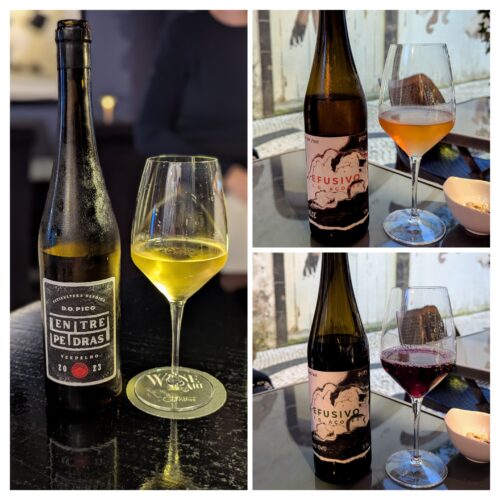
Entre Pedras white and Efusivo rosé and red
The Ilha do Pico Cooperative was founded way back in 1949 (pre-existing the Azores Wine Company by over 60 years), and it’s the other major Pico wine project to look out for. The only single-varietal Terrantez do Pico I tasted (mostly because it cost a fortune) came from the coop, made by an oenologist called Bernardo Cabral. And it did not disappoint: tart grapefruit and mandarin sat alongside tropical pineapple, nutty almonds and walnuts, and a creamy finish (perhaps from its six months of lees contact). My husband declared it to be his favourite Azorean wine (and that was without knowing how much I paid for it!).
Bernardo Cabral was also the brains behind the very first Azorean wine I bought, the day after we arrived: a blend of Arinto dos Açores and Verdelho from Strato (I’m having trouble finding any link to the 2023 vintage we had at all). And it was probably the wine that inspired my earlier article: sour oranges, tangy apricots, mandarin peel, grapefruit and a salty edge. Plus, Cabral is responsible for the Terras de Lava range of rather more accessible wines based on international varietals (I liked the Syrah-based blend a lot).
Terceira wines
I only tasted one wine from the island of Terceira, and it stuck firmly with the volcanic-themed names. Magma is a single varietal Verdelho made by Anselmo Mendes (amazingly, I also found it for sale on a US site). Here, we’re very much in the usual sour-and-saline territory, plus crunchy green apples and wet stones.
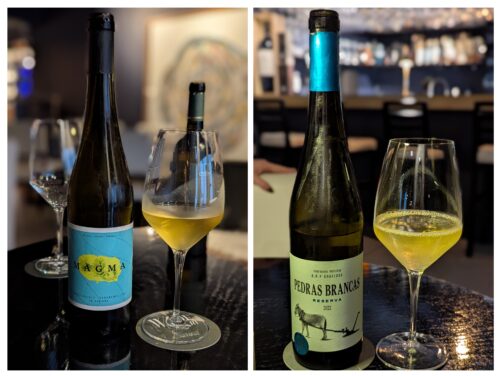
Magma and Pedras Brancas wines
Graciosa wines
Again, I only tried one wine from Graciosa island: a 2022 white reserva blend of Verdelho, Arinto dos Açores and Boal called Pedras Brancas. It was hands-down the most volcanic wine I tasted during the entire six weeks. Like the lovechild of a rock pool and the sulphurous hot springs I bathed in at Caldeira Velha. Bonkers (in a good way).