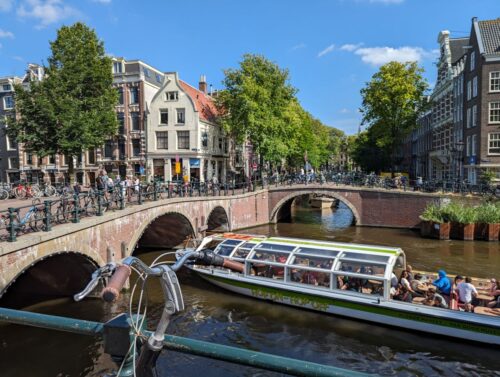
If you’ve found your way to this website, you might already live in the Netherlands – or you might be planning a weekend trip or a short break in Amsterdam. Before you’re ready to check out all my recommendations for the fantastic restaurants in Amsterdam, you’re going to need to get here! So I’ve put together this practical travel guide with tips and information to help you plan your visit.
When to visit Amsterdam
Amsterdam is a year-round destination, but the experience varies a lot depending on when you go.
- Spring (April–May) is peak season for good reason: the tulips are in bloom, the terraces fill up, and the cityscape pops against a vivid green. That said, April is also when King’s Day (27 April) takes over the entire city – it’s an extraordinary orange party, but accommodation prices spike and the streets get very crowded.
- Summer (June–August) is warm and lively, with long evenings, open-air festivals, and lots of opportunities for “wild swimming”. It’s also the busiest tourist period, so book accommodation and popular restaurants well in advance.
- Autumn (September–November) can be a good time to visit: the summer crowds have thinned, the light is beautiful (if it’s not raining), and Amsterdam Dance Event (ADE) in October turns the city into one giant electronic music festival.
- Winter (December–February) is quieter but certainly has its charms. The Amsterdam Light Festival illuminates the canals from late November into January, and the Christmas markets – while not on a par with Germany – are fun and festive. Pack warm layers.

How many days do you need?
Two days is enough to scratch the surface – a couple of museums, a canal tour, a wander through the Jordaan and a few good meals. But Amsterdam rewards a longer visit. Three to four days gives you the breathing space to explore different neighbourhoods, eat properly (in my humble opinion, the most important part), and venture slightly off the tourist track. If you want to combine a city break with a day trip to Haarlem, Zaanse Schans or Keukenhof during tulip season, add at least another day.
Getting to Amsterdam
By air
Schiphol airport is a major European hub, which means that most national carriers and budget airlines fly direct to Amsterdam. For obvious reasons, Dutch national airline KLM offers the most flights in and out of the capital, while Transavia now offers flights in and out of Amsterdam, Eindhoven and Rotterdam airports. You can compare prices among all airlines on sites like Expedia and Omio.
By train and bus
If you’re already in northern Europe, Amsterdam is easy to reach by train and bus. There are regular trains from London, Paris and Brussels on the Eurostar, while FlixBus has bus routes to the Netherlands from neighbouring Belgium and Germany. Omio can help you find the best route and means of transport.

Getting from Schiphol to the city centre
The easiest and cheapest option is the train, which runs directly from a station underneath the terminal to Amsterdam Centraal in around 15-20 minutes. Trains run up to eight times an hour during the day, and a standard second-class ticket costs around €6. You can pay by contactless bank card, credit card or mobile at the yellow machines, or buy in advance via NS (Dutch Railways). The train is also available via Omio if you want to bundle it with your wider travel planning.
If your hotel is closer to Museumplein or Leidseplein, the Airport Express Bus 397 (Connexxion-RNET) from Schiphol Plaza might suit you better – it takes around 30 minutes and costs a similar amount. Taxis and ride-hailing apps (Uber and Bolt both operate here) cost upwards of €50 to reach the city centre (hence why I never take them!).
Getting around Amsterdam
While bike rental and car rental are possible, I wouldn’t advise either of them for getting around during a short stay. Many roads are pedestrian-only, and the bike lanes can be a little terrifying until you’ve had a lot of practice on them. Better to walk (it’s a compact city) or to make use of Amsterdam’s excellent public transport network of trams, buses and the metro. Plan your journey via the GVB website.
The I amsterdam City Card: is it worth it?
If you’re planning to pack in a lot of sightseeing, the I amsterdam City Card is worth considering. It covers free entry to over 70 museums and attractions (including the Rijksmuseum, NEMO Science Museum and ARTIS Royal Zoo), unlimited use of Amsterdam’s trams, buses and metro, a free canal cruise and 24-hour bike rental. Cards run from 24 hours (€67) to 120 hours (€140).
The honest answer to “is it worth it?” is: it depends how you use it. If you’re planning to visit three or more major attractions and use public transport regularly, the maths usually works in your favour. If you only want to see one museum and plan to spend most of your time eating and wandering (no judgement – that’s what I’d do), you’re probably better off buying individual tickets. Note that the Schiphol train and the Van Gogh Museum are not included, so budget for those separately.
If you’re planning to be in Amsterdam for a longer period, or are moving here on a temporary or permanent basis, consider a Museumkaart (museum pass). It gets you free or discounted entry to the majority of museums across the whole country, and currently costs €75 per year. It’s what I have, and it pays for itself within three or four museum trips.
Where to stay in Amsterdam
Amsterdam has accommodation to suit all budgets, but book early – particularly if you’re visiting in spring or summer.
For canal-side luxury, you can’t beat the iconic Pulitzer Hotel. For a well-priced option with great amenities, book into The Social Hub (with two locations). For something quirky and unique, Hotel Not Hotel is the place to rest your head. And for excellent hotel bars and restaurants, try the laidback Hoxton or the trendy Kimpton de Witt.
Coming soon: I’m planning to write a neighbourhood guide to Amsterdam, to help you choose the right area to stay based on what you’re looking for.
Amsterdam tours: food tours and boat tours
It might feel like a tourist cliché, but taking a tour really is a great way to get your bearings. I love the food tours by Eating Amsterdam and Devour Tours (full disclosure: they’re both clients of mine). And a boat tour of Amsterdam’s canals is a must while you’re in the city (see pic below). You can find plenty of other options on GetYourGuide, Viator and Tours & Tickets.

Amsterdam sightseeing: places to see, things to do
I use the I amsterdam website to find out about things to do in Amsterdam (especially upcoming exhibitions). If you prefer to go old-school and buy a guidebook, I’ve contributed food & drink chapters to the Michelin Must See Guide, DK Eyewitness Travel Guide and Rough Guide, so I know they’re compiled by local writers.
Frequently asked questions
- Do I need to book restaurants in advance in Amsterdam? For the most popular spots, yes – especially at weekends. Many of Amsterdam’s best restaurants fill up weeks in advance. I’d recommend checking my Amsterdam Restaurant Guide before you go and making reservations before you arrive – the majority of restaurants now have online reservation systems.
- Is Amsterdam expensive? By western European standards, Amsterdam sits in the upper range. You can eat well on a budget if you know where to look (the Albert Cuyp market, Indonesian and Surinamese restaurants, Dutch fish stands), but the most talked-about restaurants and canal-view hotels come at a premium.
- What language do people speak? Dutch, but you’ll struggle to find anyone in the hospitality industry who won’t switch effortlessly to English. It’s one of the most English-friendly cities in the world. (It’s also infuriatingly difficult for foreigners to learn Dutch as a result!)
- Is it safe? Generally yes, but like any busy tourist city, keep an eye on your belongings in crowded areas, on public transport and around Centraal station. The main things to be genuinely careful about are cycling (the bike lanes are fast and unforgiving for the uninitiated) and wandering into the Red Light District late at night.
- Do I need cash? Less and less. Most restaurants, bars, shops and transport now accept contactless card payment. In fact, some only accept card payment. The only place you might need cash is at one of the markets. Also good to be aware that credit cards are not commonly used in the Netherlands: your AmEx is likely to be rejected, although you may have more luck with Mastercard. Carrying a debit/pin card is your best bet.
- What’s the weather like? Believe it or not, annual rainfall in the Netherlands is even higher than in the UK (where I come from). Pack an umbrella. But also sunglasses, thin layers, warm layers – you name it. Amsterdam frequently treats us to four seasons in one day.